
 By Annie Barry
The osprey, a large raptor, is a common sight along shorelines throughout North America in the summer months. Ospreys can be found on Governors Island during the fall and spring migrations, but they pause on the island for only a day or so to fish the abundant waters of New York Harbor. Nesting ospreys may be found throughout the New York-New Jersey harbor estuary, but no osprey has nested on Governors Island in recent years.
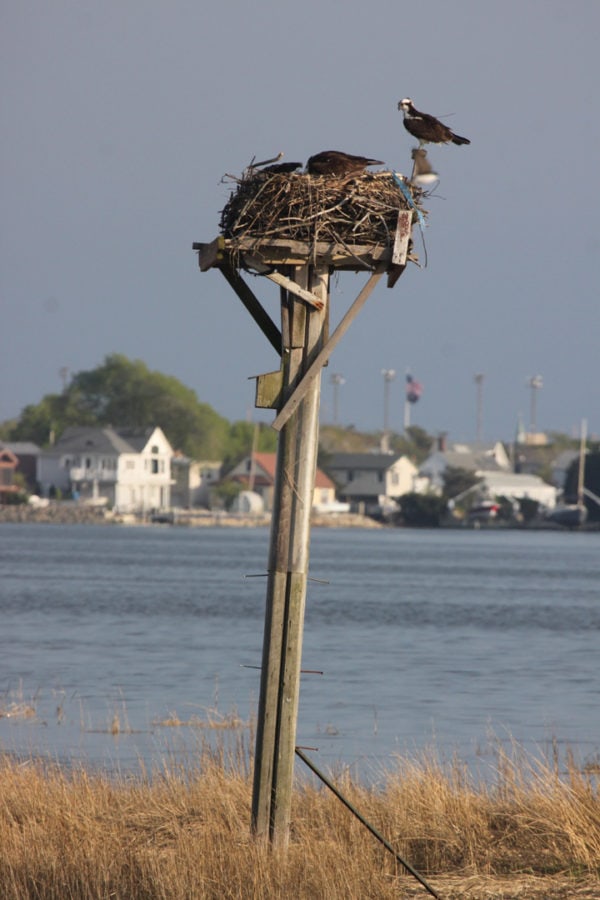
Could the erection of a nesting platform on the island change that? Perhaps. There was a platform erected by Bart Chesar and the New York Harbor School on Yankee Pier but it met it’s demise when a portion of the pier collapsed into Buttermilk Channel. Over the winter months, Earth Matter is hoping to build a new structure that will be ready in time for the ospreys’ spring migration, and we are also seeking a few volunteers to assist us at our Compost Learning Center in assembling this new platform. If you would like to be part of our Osprey Crew please drop us a line at volunteers@earthmatter.org.
Imagine the excitement of seeing these beautiful birds soaring above our rivers, bays, salt marshes, lakes and other bodies of water searching for prey, or sitting atop their nearby nests. Unlike other raptors, ospreys rely almost entirely on a diet of live fish, which they catch by diving feet first, grasping their prey in their powerful talons. Their very large stick nests are usually placed high in trees, on cliffs or, now more commonly, atop high structures, such as transformers or platforms erected specifically for them. In fact, the building of artificial nesting platforms played a role in the resurgence of the species, which suffered a disastrous population crash in many regions from the 1950s through the 1970s. DDT and other environmental contaminants contributed to the thinning of their egg shells, which led to widespread hatching failure. Chemical pollutants may also have contributed to mortality among adult birds. The reduction of the use of such agents, and the creation of artificial nesting locations, has allowed the species to recover, and it now thrives in most areas.
The osprey can grow to a length of two feet, and can often have a wingspan of almost six feet. It is brown above and has a white throat, breast and underside. Its head is white with a wide brown line through the eye, which is a striking yellow. Ospreys breed throughout North America in the summer. They lay 1-4 eggs per clutch. Hatchlings are covered with down and are totally dependent on the adults. Feeding duties are shared by the parents. The young are ready to leave the nest in about 50 days. Most ospreys migrate to Central and South America in the winter, though some populations in several southern parts of the United States do not migrate.
Perhaps one day soon an osprey will fly by and decide that Governors Island is a place that has everything it needs to rest and nest!
[Image Source: Don Riepe/American Littoral Society]