
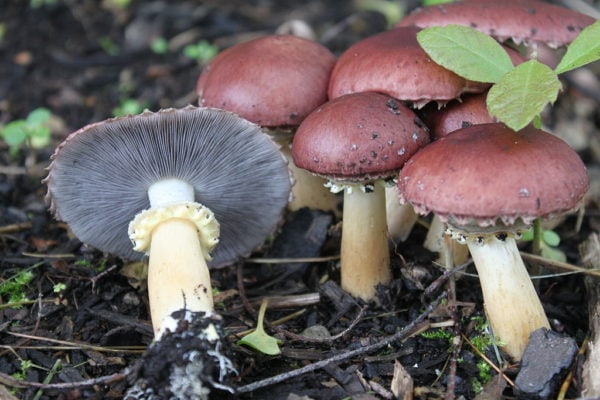
These are the type of spores that we incorporated in Mushroom Village last autumn. This image was created by user Ann B. (Ann F. Berger) at Mushroom Observer, a source for mycological images. You can contact this user here.
By Bill Koehnlein
We revere them; we’re afraid of them. We eat them; we shun them. They nurture us; they poison us. Mushrooms. They are the stuff of ancient myths and legends, coveted by pharaohs, emperors, kings and queens, shamans, soothsayers, magicians, wiccans, healers and five-star chefs—and everyone else who savors a wonderfully tasty morsel.
Mushrooms are neither plants nor animals; they are fungi, which is one of several biological kingdoms. Plants constitute a kingdom, and so do animals—these are the kingdoms we know best. Within taxonomic science (or systematics, as it is sometimes called) there are other kingdoms, such as bacteria and protozoa. There is no consensus on biological classification and scientists have, for more than a century, argued about what goes where, and taxonomical schemes are constantly being debated, revised and updated. Yet, they are in fairly solid agreement that plants, animals and fungi are their own organisms, situated in the biological roster precisely where they should be.
While all mushrooms are fungi, not all fungi are mushrooms. Yeasts and mold are also part of the kingdom known as fungi.
Recent genetic research has indicated that our grandparents might have been mushrooms. Hyperbole? Yes, obviously. Nonetheless, about forty percent of our DNA is shared with fungi; human beings and fungi evolved as one organism until approximately 1.5 billion years ago, when that organism mutated and its parts branched off, each going their separate evolutionary ways. Because of the common DNA lineage, some taxonomic scientists, in fact, have proposed that a super kingdom be created within the schema. This super kingdom would include humans and certain other primates, and fungi.
Fungi are ubiquitous, found on every continent—including Antarctica.
More than 10,000 species of mushrooms have been identified by biologists, though mycologists—scientists who specialize in the study of mushrooms and other fungi—say that there are up to 1.5 million species that have not yet been discovered, identified or classified (American Journal of Botany, January 19, 2011). There are four broad categories of mushroom—saprotrophs, mycorrhizae, parasites and endophytes; these categories are defined by mushrooms’ symbiotic relationships to plants and other organic matter. The saprotrophs function very much like composting agents, helping to break down dead and decaying matter. Mycorrhizae nurture and nourish plants (including trees) through the use of mycelia (a vast and complex system of mushroom “roots”) that surround, or sometimes join with, a host plant to provide nutrients to the plant; the plant, in turn nourishes the mycelia and, ultimately, the mushroom. Parasitic mushrooms invade a host, but bring no nourishment to it, and eventually the host will die or its vitality will be severely compromised. Relatively little is known about endophytic mushrooms. They do invade plants, yet the “invasion” of the host seems to be beneficial, but the symbiotic mechanism is not yet understood. Endophytes are currently under scientific scrutiny to determine their characteristics more precisely.
Mushrooms inspire awe among many people. Some people fear mushrooms, though that fear is based on an exaggerated notion of the chance of dying from consuming poisonous mushrooms. In North America, there are only two deadly poisonous species of mushroom, Amanita phalloides (the death cap mushroom) and Amanita bisporigera (destroying angel). These species contain deadly amatoxins; the fatality rate among people who have ingested them is well over fifty percent, and those who survive will do so with extensive liver and kidney damage and might wind up on dialysis for the rest of their lives. Most poisonous mushrooms, though, will make people sick, with symptoms ranging from mild to severe, but are unlikely to kill them. People purchasing mushrooms in grocery stores need not worry about poisoning; almost all mushrooms sold in stores are cultivated under rigorously-controlled conditions. A few wild-gathered mushrooms sometimes make their way into specialty stores, and the pickers who gather them must be certified to commercially distribute or sell them. For people who would like to forage their own mushrooms, the best tip for beginners is to learn one or two easily identifiable species that cannot be confused with any other mushroom—boletes, chicken mushroom (also called sulfur shelf) or chanterelles are some examples—and go out to hunt for them. Seasoned mushroom pickers all say that the unidentifiable LBMs (“little brown mushrooms”) should be left where they were found: in the ground. Prudent picking and foraging can be a pleasurable pastime, and its reward is a mound of precious savory jewels on the dinner plate.
One of the best known hallucinogenic mushrooms, Amanita muscaria (fly agaric or magic mushroom) contains a psilocybin-like substance called muscarine, and can be found throughout North America. Religious rituals involving hallucinogenic, or psychedelic, mushrooms have been part of indigenous and earth-based cultures throughout the world for centuries.
Many mushrooms are quite edible, with some—boletes, truffles, morels, chanterelles, chicken, shitake and maitake, among others—regarded as “choice” edibles. All have a nutritional wallop, and a few mushrooms—shitake, for instance—are among the very few food sources of vitamin D. Most mushrooms have excellent medicinal properties, especially beneficial for human immune systems. Culinary mushrooms like shitake and maitake (also known as hen-of-the-woods) have been used for centuries in Traditional Chinese Medicine (TCM), and in recent years have become the focus of study among western medical researchers. Non-culinary mushrooms, like reishi, turkey tail, chaga and cordyceps have been used medicinally in the treatment of immune disorders, cancer and numerous other illnesses.
Mushrooms’ effect on and relationship with the earth’s varied ecosystems is profound. Paul Stamets, perhaps the world’s most prominent expert in the field of mycology, says, “Look under any log lying on the ground and you will see fuzzy, cobweblike growths called mycelium, a fine web of cells which, in one phase of its life cycle, fruits mushrooms. This fine web of cells courses through virtually all habitats—like mycelial tsunamis—unlocking nutrient sources stored in plants and other organisms, building soils. The activities of mycelium help heal and steer ecosystems on their evolutionary path, cycling nutrients through the food chain. As land masses and mountain ranges form, successive generations of plants and animals are born, live, and die. Fungi are keystone species that create ever-thickening layers of soil, which allow future plant and animal generations to flourish. Without fungi, all ecosystems would fail.” (Stamets, Paul. Mycelium Running: How Mushrooms Can Help Save the World. Berkeley: Ten Speed Press, 2005. ISBN-13: 978-1-58008-579-3; ISBN-10: 1-58008-579-2.)
Stamets and other researchers have examined the role of mycelia in the health of ecosystems, and have used it successfully in containing and cleaning soil- and water-borne environmental pollutants, toxins and contaminants. Mushroom cultivation and growing is a fledgling urban project that has the potential to not only improve the quality of the environment, but to offer communities another dimension to urban gardening and a new project to promote cooperative economic sustainability.
For people interested in learning more about mushrooms, including how to forage for them, check out the New York Mycological Society, which hosts year-round educational events and seasonal mushroom foraging walks in New York City and elsewhere in the metropolitan area.