
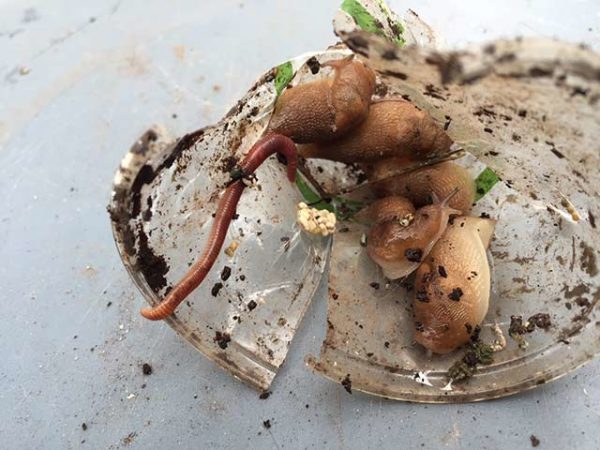
Slugs lay average of 30 eggs (see white eggs in center of the photo). They use their top 2 antennae for finding their way and their bottom antenna for smell and taste.
Marisa DeDominicis and Infinitae Stockton
This month’s “Nature Celebrity” is the land slug. Curiously NOT closely-related to the garden snail!
Slugs do not have a hard outer shell (it’s the snails that have shells). They do both have soft, slimy bodies that necessitate they live in moist environments such as a well-maintained compost heap!
The mucus (slime) they secrete helps keep their bodies moist. This mucus is foul-tasting which helps deters birds and beetles from wanting to take a bite out of them. It also deters mites, nematodes, and flies who would love to have the slug play host (they are parasites). The entire bottom side of the slug is referred to as the “foot”. The foot moves in waves of muscular contraction, squirting out a layer of mucus that coats the “ground” that it “steps” on, glides it along – but not so wet that it slips – allowing the slug to descend steep vertical slopes! Their slime “trail” attracts mates…
Slugs are hermaphrodites and have both male and female sex organs. Though they come equipped with the necessary organs to get the job done, it still takes two to tango. You can see their fancy footwork in our photo of their “compostable cup ballroom” that we found while turning one of our backyard compost devices.
Slugs can be found feasting on mushrooms, flowers, strawberries, carrots, peas, cabbage… (some carnivorous slugs also eat other slugs, snails and earthworms). If these plants are in the compost pile (after we are done with them) it is great to have our celebrity decomposers around!
However, our celebrity also eat these plants before the harvest as well. Slugs make holes in crops, which makes the crops more vulnerable to rot and disease. Not to mention WE want to enjoy hole-less crops! A couple of slug “control” methods for organic growers are as follows – pour beer in a jar and set next to the crop. This attracts the slugs to crawl in (then they drown). Also, try putting diatomaceous earth (d.e.) around the base of the plant. The slug goes for the plant, absorbs the d.e. which causes the slug to dry out (which causes it to die).
Dead slugs decompose readily in the compost pile, a nitrogen source, they break down very quickly due to their high moisture content.
Thanks to Wikipedia for a lot of the information presented in this article.