
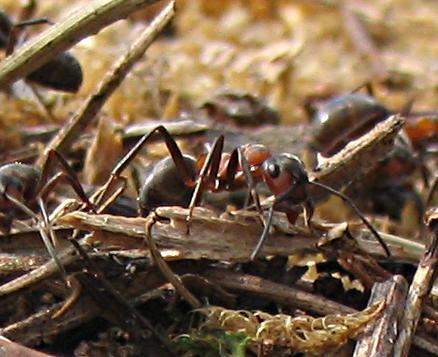
“Formica polyctena”. Licensed under CC BY-SA 2.0 de via Commons – https://commons.wikimedia.org/wiki/File:Formica_polyctena.jpg#/media/File:Formica_polyctena.jpg
by Marisa DeDominicis + Charlie Bayrer
Our beloved decomposer friends, the ants, make up 15-25% of the terrestrial animal biomass! Does that signify that ants are the single most numerous animal on earth?
Ants are part of our decomposer community. Ants’ tearing apart organics to transport small food particles to their nest and adding their excretions (poop) to the compost pile are beneficial. Their foraging tunnels allow air to move through the pile. However, their presence indicates dry and undisturbed conditions as they will only move in when their tunnels will not be too moist to collapse. Such dry conditions are not optimal in the compost pile; we want decaying materials to be as moist as a wrung out sponge.
Ants are true community builders, working together as a unified entity. A colony consists of castes: worker, soldier’s drones and queens. There may be a few queens in a colony, living as long as 30 years. Workers, on the other hand, live only 1-3 years. They have symbiotic relationships with a range of species-other ants, insects, fungi, and plants. They interact in mutual co-operation, creating interdependent benefits for both organisms. An example – ants defend aphids and mealy bugs from predators. In exchange these insects share the food they make, honey dew, which are pinhead sized clear balls of sugars (sap) sucked from plants. Another example is that ants cultivate certain species of fungi in their gut that they excrete. These fungi are then used by other micro-organisms to break down organic matter. Wow! They are the only non-mammals where interactive teaching of the young has been observed(!).
Ants have keen senses. These perceptive insects leave scent pheromones on the trail to indicate to their forager mates where dinner is waiting for them to bring home to the queen, workers and young. This can be as far as 700 feet from the nest! In addition to scent and tactile clues, specialized cells in their compound eyes help them navigate by the position of the sun. Pheromones are also used to indicate the presence of predators. Predators can be incapacitated by a bite injection of formic acid. This is what may makes your own ant bite sting!
Ants are anatomic descendants of wasps. Thus, queens have wings till after they take their pre-nuptial flight when the wings are lost. They have 3 body parts: head, mesosoma (thorax) and metasoma (gaster – stomach/gut). They have an exoskeleton and 6 legs. Like many of our macro-organism friends that decompose organics in mesophilic conditions, ants’ level of activity decreases as ambient temperatures plunge. They become dormant in the winter months.
Thanks to Wikipedia for a lot of the information presented in this article.